How Was Roman Art Influenced by Greek Art edu gov
Larry Slawson received his Masters Degree at UNC Charlotte. He specializes in Russian and Ukrainian History.
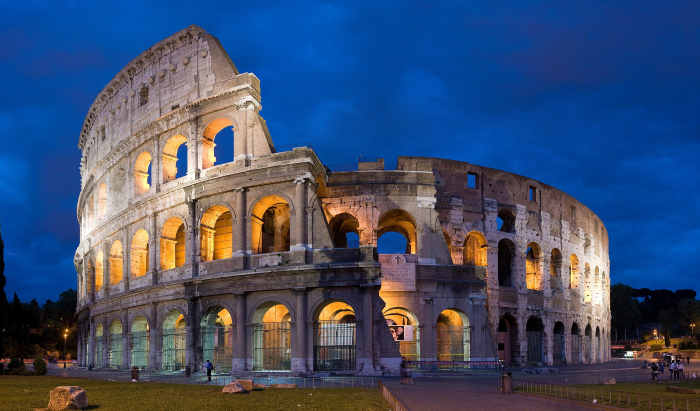
Picture of the Roman Colosseum (Modern-Twenty-four hour period).
Ancient Hellenic republic's Influence on the Roman Empire
The Ancient Greek ideas of warfare, religion, literature and art, likewise as architecture all played meaning roles in the development of future civilizations. From the architectural designs implemented by engineers worldwide, to the use of the Greek alphabet as a basis for numerous languages the ancient Greek's formed the foundation of civilization equally nosotros now know it today. Perhaps the Greek's most heavily influenced civilization, however, can be seen with the Roman Empire. Following the conquests of Alexander the Dandy, Greece became a center for new ideas and concepts within the Mediterranean. Years later, Greek noesis of literature, art, architecture, and warfare were all implemented to corking lengths past the Romans. With this heavy employment of Greek concepts, therefore, information technology could be ended that Rome's success as an empire was largely due to the influence of the ancient Greek civilizations.
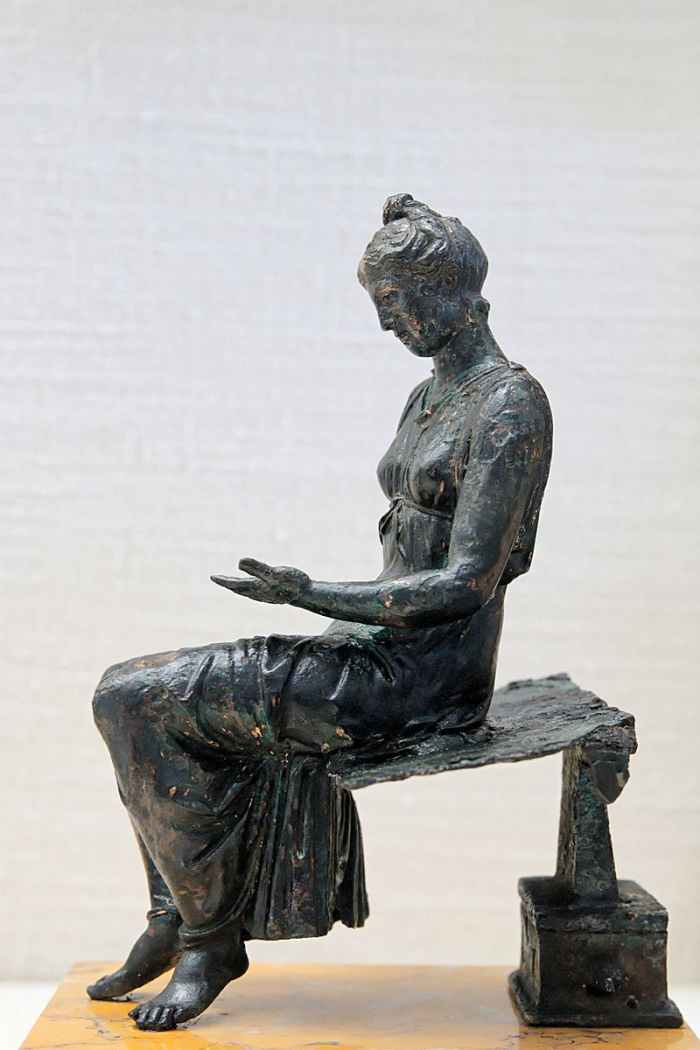
Statuette of girl reading in ancient Rome. Notice the creative person'south attention to detail in this statue.
Educational activity and Language
Greek ideas of education and language were highly sought within the Roman Empire. Greek slaves within Rome "were in loftier demand as tutors, musicians, doctors, and artists" (Spielvogel, 165). Teachers were often of Greek descent, and it was considered mandatory that "upper class Romans had to acquire Greek and Latin in order to prosper in the Empire" (Spielvogel, 165). Rome deeply admired Greek educational concepts. To the Romans, Greeks were considered "masters of philosophy and the arts" (Fiero, 131).
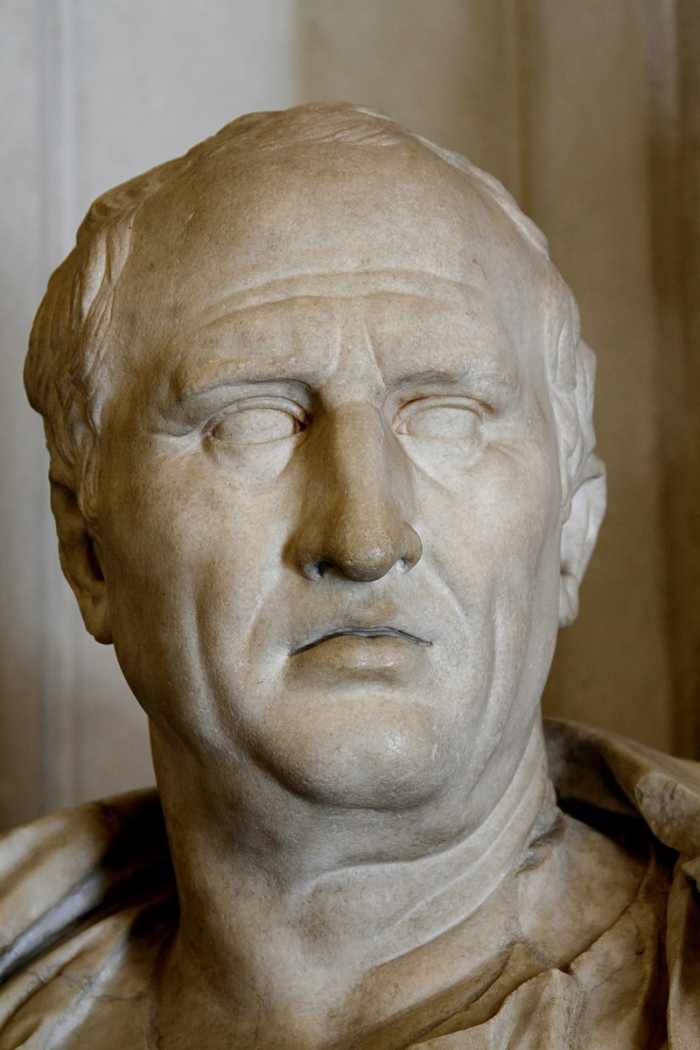
Cicero.
Literature, Drama, and Music
Perhaps one of Greece'due south virtually influential concepts adopted by the Romans tin can be seen with literature, drama, and music. Literature, substantially, "served equally a model for Rome, suggested themes for treatment, widened the mental horizon, opened new vistas," and "inspired new desires" within the Empire (Wedeck, 195). Examples of this can be seen with Ennius' adoption of the Greek hexameter, equally well every bit with Plautus and Terence'southward "manners and customs depicted in their plays" that were mainly Hellenic in nature (Wedeck, 195). In improver, the poet Virgil'southward literary works relied largely upon Greek influence as well. The Aeneid was "inspired heavily past Homeric epics and was largely undertaken as a piece of work meant to rival Homer" (Fiero, 140). Fifty-fifty Cicero recognized the importance of Greek literary influence which tin be seen with the following statement:
"…And sometime as I myself am, it is but lately that I acquired a knowledge of the Greek language; to which I applied with the more zeal and diligence, as I had long entertained an earnest desire of becoming acquainted with the writings and characters of those excellent men, to whose examples I have occasionally appealed…" (Cicero, 224).
Substantially, Cicero "recognized the Greeks as artists, accomplished in literature, in the fine arts," and "men who supplied Rome with amusement and educational activity of various kinds" (Wedeck, 196). Thus, Cicero gives a descriptive idea of the way in which Greek concepts were explored by the Romans.
Greek drama and music too heavily influenced the Roman Empire every bit well. Roman dramas were crudely modeled on those of the Greeks and were largely "moral and didactic in intent" often drawing upon themes from both Greek and Roman history. (Fiero, 145). Still, potent differences between Greek and Roman dramas can be clearly seen. Whereas Greek dramas were typically religious in nature, Roman dramas were used mostly for amusement purposes simply (Fiero, 145). The inclusion of music within Roman lodge was as well a straight result of Greek influence as well. While little is known about Roman music, due to a lack of sufficient records, it is believed that Greek musical theories, also as most Greek musical instruments were adopted past the Romans (Fiero, 158). Just like the Greeks, many Romans believed that music held special magical backdrop and spiritual powers (Fiero, 124). Edifice upon the music and religious ties maintained by the Greeks, however, the Romans expanded on the concepts of music by incorporating it into public entertainment, and their military machine. "Brass instruments, such as trumpets and horns, and drums" became exceedingly popular during war machine processions (Fiero, 158). Thus, like literature, both Greek drama and music were heavily influential in early Rome.
"…And old equally I myself am, it is but lately that I caused a knowledge of the Greek language; to which I applied with the more than zeal and diligence, as I had long entertained an earnest desire of condign acquainted with the writings and characters of those excellent men, to whose examples I accept occasionally appealed…"
— Cicero
Architecture and Art
In addition to literature, drama, and music the Greeks were also instrumental in influencing Roman compages and fine art. Relying heavily upon Greek models, the Romans often constructed buildings and houses that implemented Greek styles such equally colonnades and rectangular based designs. Substantially, all "furniture, utensils, houses" and "colonnades" were all the issue of Greek models (Wedeck, 197). The Roman temple of Maison Carree is a terrific example of the Greek influence upon Roman architecture.
Greek and Roman architectural designs too varied to a large caste as well, however. Building upon Greek architectural concepts, the Romans incorporated concrete every bit a means of structure that allowed them to create enormous buildings unlike annihilation seen in Greece, and implement "forms based on curves such as the curvation, vault, and dome" (Spielvogel, 164). All the same, Greek architectural design and artwork was prevalent in most every Roman structure. Even the enormous Roman Colosseum displayed signs of Greek influence. At the Colosseum "on each level of the exterior, arches were framed by a serial of decorative, or engaged, columns displaying the three Greek orders: Doric (at ground level), too as Ionic and Corinthian" (Fiero, 147).
Greek fine art in the grade of portraits and statues heavily influenced Roman artists likewise. By the 3rd and iind Centuries B.C. the Romans incorporated many different forms of Greek artwork and design (Spielvogel, 163). Greek statues, in a higher place all else, were among the nearly popular designs incorporated by the Romans. Hellenic statues could ofttimes be seen within public buildings and fifty-fifty inside private homes (Duiker and Spielvogel, 141). With this large influx of Greek fine art the Romans underwent a dramatic Hellenization process within their society. As Jerome Pollitt explains well-nigh Greek art in Rome: it was only "inevitable that, as time went by, the Romans would begin not simply to examine their artistic subtleties and differences only too to assess what their value was, if any, to Roman lodge" (Pollitt, 155). Throughout early Roman history many replicate Greek statues were designed by Roman sculptors, many of which differed slightly from their Greek counterparts. Whereas Greek statues were largely idealistic works of art lacking imperfections, Roman statues focused on ideas of realism and incorporated even the "unpleasant physical details" of the discipline (Duiker and Spielvogel, 141-142). The same can be said of Roman paintings which derived from Greek influence likewise. Inspired past Greek murals, Roman painting typically included scenes from "literature, mythology, and everyday life" (Fiero, 156).
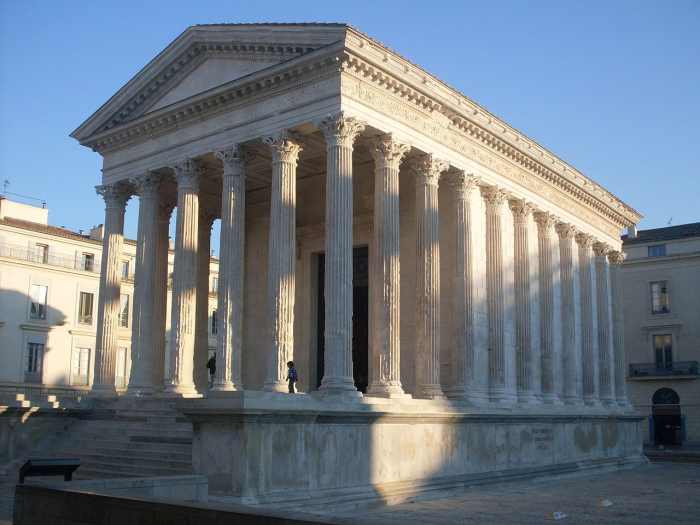
Maison Carree. Notice its architectural blueprint.
Religion
In addition to literature, art, and architecture the Romans were too heavily influenced by Greece in regards to religion. Similar that of the Greeks, early Roman religious behavior implemented a polytheistic system of worship based around gods and goddesses. Well-nigh all of the Roman gods share basic characteristics of the Greek gods which demonstrates how instrumental Greece was in the overall development of Rome. Neptune, the Roman god of the sea, shares a direct correlation with the Greek god Poseidon. The head god Jupiter, on the other hand, straight resembles the Greek god Zeus. Non all roman gods were given different names from their Greek counterparts, nonetheless. The Greek god Apollo, for instance, was adopted by the Romans and "was established as a deity of medicine and healing" (Bailey, 120). He maintained his Greek character, was worshiped with Greek rites, and maintained his Greek proper noun in its entirety (Bailey, 121). The only deviation betwixt the Greek and Roman versions of Apollo was his functions. Whereas the Greeks worshiped Apollo for a variety of reasons, the Romans worshiped Apollo for his medicinal and healing characteristics. As was typical with Rome during this fourth dimension, the Romans were willing to admit foreign deities, just "she would brand her own terms with them" (Bailey, 121). Thus, many Roman gods and goddesses were, essentially, Greek gods in darkening. The role that Greece played in Roman organized religion, withal, was essential to Roman religious development. Hellenic republic'due south role can exist summed upwardly with Cyril Bailey's statement: "it may exist questioned whether Rome would ever accept reached the total measure of anthropomorphism, had it not been for her contact, first indirectly, so directly with Greek religious thought and conceptions" (Bailey, 112).
Coil to Continue
Read More From Owlcation
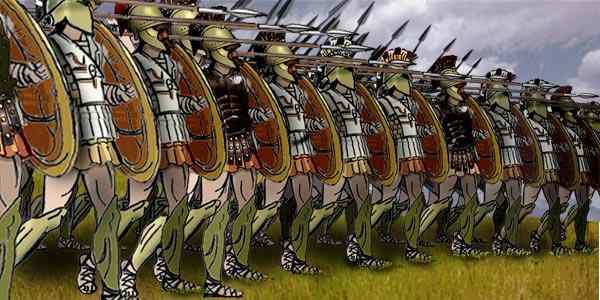
Mod depiction of the phalanx; a deadly troop formation from Greek and Roman times.
War machine Doctrines
Finally, one of Greece's most important contributions to the Roman Empire tin can be seen with their ideas of military formations and tactics. Greek military thinking became an intricate part of Roman military strategy and success. The Greek thought of the phalanx coupled with the concepts of teamwork and unity became the footing for the future Roman Legions. The Greek phalanx incorporated a system of order and movement of troops that was widely respected amongst the Romans (Lendon, 281). Julius Caesar later embraced this system of fighting while also integrating changes based on the Roman's feel (Lendon, 281). Thus, the Roman armed forces was based upon a blending of Greek war machine theory and traditional Roman military machine thinking (Lendon, 278).
Whereas the Greek phalanx system was comprised of a compact unit of measurement of Greek troops marching shoulder to shoulder, the Roman Legion blueprint incorporated a design that allowed for a loosely deployed force. Caesar recognized the office that terrain played in battles and quickly learned that poor topography caused general disorder among the Greek phalanx (Lendon, 289). Since uneven basis made information technology hard to remain closely compacted the Greek phalanx was decumbent to breaking apart under attack. Maintaining order and closeness inside the Greek phalanx was of the utmost importance and is described by Thucydides:
"All armies, equally they come together, button out toward the right wing, and each side overlaps the enemy's left with its own right, because in their fright each human brings his uncovered side as close as possible to the shield of the man stationed to his right, thinking that the best protection is the tightness of the endmost up." (Thucydides 5.71.i) (Krentz, 52).
Thus, for Caesar's loosely deployed Roman Legion the terrain was far less of a threat, and the vulnerability of the compact Greek phalanx "breaking apart" was a problem overcome (Lendon, 289). Even with these shortfalls in Greek strategy, however, their ideas of military deployment and formation played decisive roles in the futurity success of the Roman military. Greek concepts of trireme warships, catapults (artillery), armor, and siege weapons were all heavily incorporated into the early Roman Empire as well and played a pivotal role in future Roman conquest.
Conclusion
In conclusion, ancient Greece played a tremendous role in the evolution of the Roman Empire. Literature, didactics, fine art, architecture, faith, and armed forces theories demonstrate only a few of the contributions made past the Greeks in Rome. Using Greek ideas and concepts to their advantage, the Romans continuously improved on Greek ideologies and thoughts which, ultimately, immune for the creation of one of the most powerful empires the world ever saw. Greek thought was highly avant-garde for its fourth dimension. If information technology had not been for the numerous divisions that existed within Greek civilization, Greece might accept potentially rivaled that of the Roman Empire had information technology been unified. Lacking cultural divisions, the Romans implemented these aforementioned bones Greek ideologies allowing for them to become a dominant ability in the earth for many years to come up. Thus, every bit one can clearly see, the Romans success was largely based upon the Greeks. Without Greece information technology could be argued that Rome would not have been equally successful as it was, and the world as we know it today would be far dissimilar.
Suggestions for Further Reading
Enos, Richard Leo. Roman Rhetoric: Revolution and the Greek Influence. Anderson, Southward Carolina: Parlor Press, 2008.
Freeman, Charles. The Greek Accomplishment: The Foundation of the Western Earth. New York, New York: Penguin Books, 2000.
Newby, Zahra. Greek Myths in Roman Art and Culture: Imagery, Values and Identity in Italy, l BC-AD 250. Cambridge: Cambridge University Press, 2016.
Works Cited
Books / Articles:
Bailey, Cyril. Phases in the Faith of Ancient Rome. Berkeley, California: Academy of California Press, 1932.
Cicero, Marcus Tullius. The Orations, Volume 3. Translation by William Duncan and Thomas Cockman. New York: Harper & Brothers, 1839.
Duiker, William J., and Jackson J. Spielvogel. Globe history. 5th ed. Belmont, California: Thomson/Wadsworth, 2007.
Fiero, Gloria 1000.. The Humanistic Tradition. 5th ed. Boston: McGraw Hill, 2006.
Krentz, Peter. "The Nature of Hoplite Boxing," Classical Antiquity, Vol. 4, No. 1 (1985).
Lendon, J.E. "The Rhetoric of Combat: Greek Armed forces Theory and Roman Culture in Julius Caesar'southward Battle Descriptions," Classical Antiquity, Vol. 18, No. two (1999).
"Nemausus." Livius Articles on Ancient History. http://www.livius.org/ne- nn/nimes/nimes2.html.
Pollitt, Jerome J. "The Impact of Greek Art on Rome," Transactions of the American Philological Association, Vol. 108 (1978).
Spielvogel, Jackson J.. Glencoe World History. New York, Due north.Y.: Glencoe/McGraw-Hill, 2003.
Wedeck, Harry E. "The Roman Attitude toward Foreign Influence, Specially toward the Greek Influence during the Republic," The Classical Weekly, Vol. 22, No. 25 (1929).
Images / Photographs:
Wikipedia contributors, "Cicero," Wikipedia, The Free Encyclopedia, https://en.wikipedia.org/due west/index.php?title=Cicero&oldid=887041731 (accessed March 11, 2019).
Wikipedia contributors, "Maison Carrée," Wikipedia, The Free Encyclopedia, https://en.wikipedia.org/w/alphabetize.php?title=Maison_Carr%C3%A9e&oldid=870969372 (accessed March 11, 2019).
Wikipedia contributors, "Phalanx," Wikipedia, The Free Encyclopedia, https://en.wikipedia.org/westward/index.php?title=Phalanx&oldid=884621778 (accessed March eleven, 2019).
Wikipedia contributors, "Roman Empire," Wikipedia, The Costless Encyclopedia, https://en.wikipedia.org/w/index.php?championship=Roman_Empire&oldid=887102621 (accessed March eleven, 2019).
Wikipedia contributors, "Didactics in aboriginal Rome," Wikipedia, The Free Encyclopedia, https://en.wikipedia.org/w/alphabetize.php?championship=Education_in_ancient_Rome&oldid=885974158(accessed March 11, 2019).
This content is authentic and true to the all-time of the writer's knowledge and is non meant to substitute for formal and individualized communication from a qualified professional.
© 2019 Larry Slawson
{} on April 14, 2020:
i similar
Larry Slawson (writer) from N Carolina on March thirteen, 2019:
@Alexander Yes indeed. Totally agree. Could actually plow this article into "Greek Impact on the World" haha.
Alexander James Guckenberger from Maryland, United States of America on March 12, 2019:
The Greeks have been heavily influential on a number of cultures.
Larry Slawson (author) from Due north Carolina on March 12, 2019:
Aye, Greek history (forth with Soviet and Russian history) has always fascinated me. Its astonishing to come across how much of an impact they had on the modernistic earth.
Liz Westwood from U.k. on March 12, 2019:
This takes me dorsum to my classical studies many years ago. Modern western guild owes a lot to its Greek and Roman fore runners.
Sam Shepards from Europe on March 12, 2019:
Greek culture was the soul of the mechanic Roman Empire. Maybe a little unfair, but the Romans were simply so practical that it overschadows nearly of their other achievements like fine art and literature.
Larry Slawson (writer) from North Carolina on March 11, 2019:
@Marja, cheers so much! I'm glad you enjoyed :)
Marja Radic from Carve up, Croatia on March eleven, 2019:
Dearest this article! And aye, I concord with all written. Without Greeks, the Roman empire wouldn't be an empire at all, I recollect.
Source: https://owlcation.com/humanities/Greek-Influence-on-Rome
0 Response to "How Was Roman Art Influenced by Greek Art edu gov"
Postar um comentário